
Healthcare Software Development
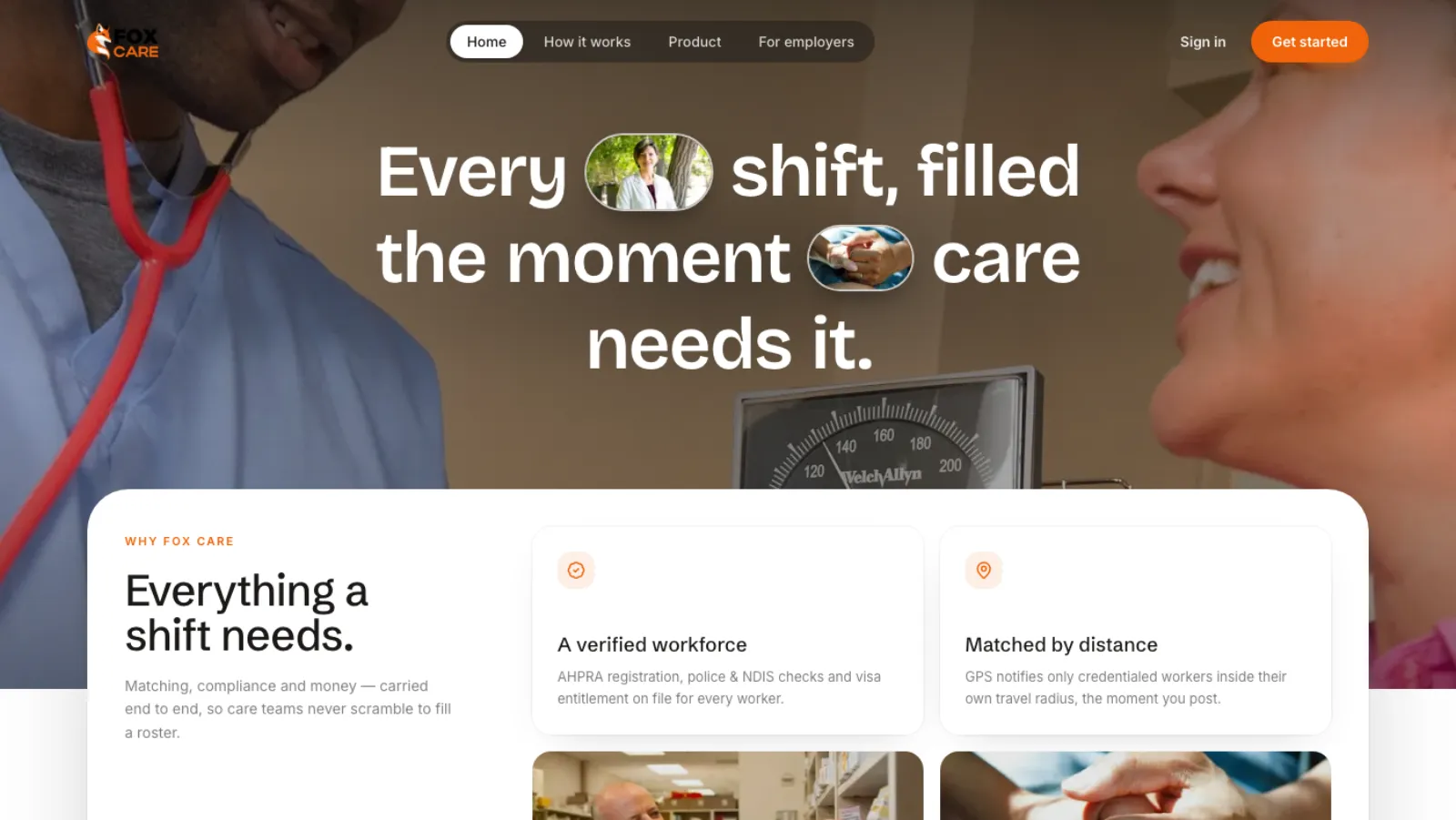
ReliaBuilds is a healthcare software development company for startups and SMBs in the US, UK, Australia and Canada. We design and build healthcare apps, portals and marketplaces with a fixed scope and quote before any code, weekly demos on staging, and a repository you own. We built Fox Care, an Australian healthcare shift marketplace with AHPRA-verified workers, so we have shipped a regulated, two-sided product.
What does a healthcare software development company do?
A healthcare software development company designs, builds and maintains the software that patients, clinicians, facilities and administrators use: web apps, mobile apps, portals, marketplaces and the integrations behind them. At ReliaBuilds that means a product team of designers and engineers working from a fixed scope, with weekly demos, delivering code you own. We build for startups and SMBs in the US, UK, Australia and Canada.
Most healthcare startups we talk to are not building a hospital system. They are building one narrow product: a booking flow, a staffing marketplace, a patient-facing portal, an internal tool that replaces spreadsheets. That is the work we are suited to, from the first MVP through to a product that keeps shipping. We design it (UI/UX design), build the web side (web development) and the iOS and Android apps (mobile app development), and you deal with one team throughout.
What have we built in healthcare?
We designed and built Fox Care, an Australian healthcare shift marketplace launched in 2026. It matches AHPRA-verified workers to shifts by distance, applies award rates and automates weekly invoicing. It is a two-sided product with professional registration checks and pay rules built into the core flows.
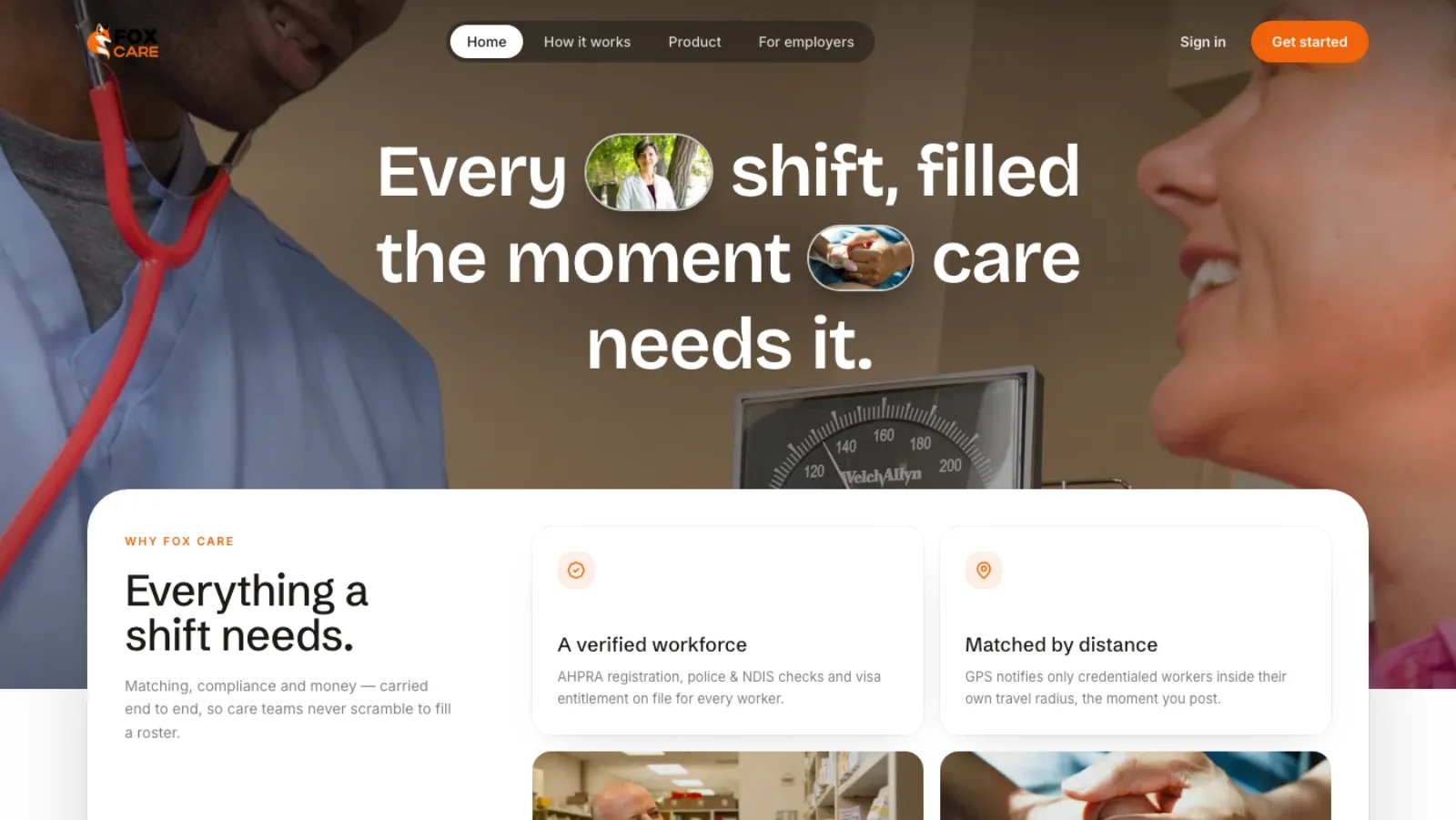
Two users with very different needs sit on either side. Workers want to find a shift near them and see what they will be paid. Facilities want to trust who turns up. The design problem was trust and speed: verified profiles, distance matching and clear pay up front. The engineering problem was encoding real rules (registration status, award rates, invoicing cycles) so people do not do it by hand every week.
That is the closest proof we have for healthcare marketplaces and staffing platforms. For the local market context see software development for Australian startups, and for other builds see the projects page.
What healthcare software can we build?
We design and build the full range of healthcare software, from patient apps to clinic back-office tools and AI features. Each is quoted as a fixed scope after discovery, and if your idea is not on this list, send it anyway.
| Product type | Typical users | What the first version usually includes |
|---|---|---|
| Healthcare marketplace | Providers or workers on one side, facilities or patients on the other | Verified profiles, search and matching, booking, payments or invoicing, admin console |
| Staffing and shift platform | Clinicians, care workers, facilities | Credential checks, availability, shift posting and matching, timesheets, pay rules |
| Patient portal or booking app | Patients and front-desk staff | Accounts, appointments, reminders, secure messaging, forms |
| Internal clinic or care tool | Staff, managers | Role-based access, scheduling, records views, reporting |
| Telehealth or remote-care front end | Patients and clinicians | Video integration, scheduling, notes, notifications |
| Telehealth and video consultation | Patients, GPs, specialists | Booking, video visits, consult notes, e-prescription hand-off to your provider |
| Remote patient monitoring | Patients at home, care teams | Device or wearable data intake, thresholds and alerts, clinician dashboard |
| Mental health and therapy app | Clients, therapists | Intake forms, session booking, journaling, secure chat, progress tracking |
| Clinic and practice management | Reception, practitioners, owners | Calendar, patient records views, billing hand-off, reporting |
| Aged care, NDIS and home care | Support workers, coordinators, families | Rostering, visit check-in, care notes, incident reports, family updates |
| Pharmacy and medicine delivery | Patients, pharmacists, couriers | Catalogue, prescription upload, order tracking, delivery status |
| Lab and diagnostics portal | Patients, labs, referring doctors | Test booking, sample tracking, results release, PDF reports |
| Fitness, wellness and nutrition app | Members, coaches | Plans, habit tracking, content library, subscriptions |
| AI symptom triage and health chatbot | Patients, front desk | Guided intake, FAQ answers from your approved content, hand-off to a human |
| Medical billing and claims tools | Practice managers, billers | Invoice generation, claim status tracking, exports to your accounting system |
| Care coordination and referral platform | Clinicians, hospitals, community services | Referrals, shared care plans, task lists, secure messaging |
| Health data dashboards and analytics | Operators, managers | KPIs from your existing systems, role-based views, scheduled reports |
We integrate with the third-party services you already use (payments, calendars, video, email and SMS) rather than rebuilding them. Where a product touches an electronic health record or a regional registry, tell us on the first call so the integration is scoped, not discovered late.
How do you build a healthcare marketplace?
You build it in a fixed order: define the two sides, verify who is allowed on, match them, then handle money. A marketplace is easier to ship in stages, because each stage proves one assumption. We follow this sequence, and it is the sequence that shaped Fox Care.
- Define both users. Write down what each side needs to decide and what would make them leave. Design two separate flows, not one shared screen.
- Verification. Decide which credentials, registrations and checks gate entry, and who confirms them. This is the trust layer and it should exist before matching does.
- Matching. Search, filters and distance or availability logic. Keep rules simple in v1 and measurable.
- Transactions. Bookings, pay rules and invoicing. If pay follows an award or contract, encode it once and test it against real examples.
- Admin and reporting. The back office is where operations live. Build the tools your team needs to resolve problems without a developer.
Our MVP development page shows how we cut scope to a first release that real users can test in 6-12 weeks for a typical web product.
How do you handle privacy, security and compliance in healthcare software?
We design for the privacy and security requirements you give us, and we scope them in discovery before any code is written. Healthcare data is sensitive, and the rules differ by market: HIPAA in the US, UK GDPR in the UK, and the Australian Privacy Act in Australia. We do not claim certifications, and compliance is a property of your whole operation, not of a codebase alone.
What we do in practice:
- Least-privilege access. Role-based permissions so each user type sees only what they need.
- Encryption and secrets. Data encrypted in transit and at rest on the managed services we use, with secrets kept out of the code.
- Your cloud account, your region. Hosting is opened in your name, so you choose where data lives. Say so early if it must stay in one country.
- Audit trails. Logging of key actions where your rules require it.
- A security review before launch. We recommend a security audit for any product that holds health or payment data.
Why use an outside team instead of hiring in-house?
An outside team gets you a designed, built and tested first release without a recruitment cycle, and you keep the code. Hiring a lead, two engineers and a designer takes months before a line ships. Healthcare startups often cannot wait, because a pilot customer or funding window is open now.
| In-house hires | ReliaBuilds | |
|---|---|---|
| Time to start | Recruitment first | Discovery call this week |
| Scope and cost | Salaries before a product exists | Fixed quote after discovery |
| Visibility | Whatever your team reports | Weekly demos on staging |
| Code ownership | Yours | Yours, from the first commit |
| Skills | Hire for each one | Design, web, mobile and security in one team |
We work as a distributed team across the UK, India and Bangladesh, working your business hours in any time zone, with same-day replies and invoices in your currency. The model is the same one that built Fox Care: the client set product direction and we ran design, build and launch. For how the monthly model works, see dedicated development team.
How much does healthcare software development cost?
We quote a fixed figure after discovery, based on the number of screens and user flows, the integrations, and the rules that must be encoded. We do not publish prices, because two healthcare products with the same idea can differ widely in verification, payments and integrations. A marketplace with credential checks and automated invoicing is a bigger scope than a booking page.
You can use the budget bands on our contact form to tell us what you have in mind. If the scope is too big for that figure, we say so and propose a smaller first release rather than stretching a plan.
How does a healthcare project start with us?
It starts with a paragraph from you and ends with a launched, monitored product. The steps are the same for every engagement.
- Brief. Describe the product, the users and any regulation that applies. We reply within 24 hours.
- Discovery. Goals, users, must-haves and the "not in v1" list. You receive a roadmap, a technical plan and a fixed quote.
- Design. A clickable prototype and design system, tested with real users where possible.
- Build. Weekly demo builds on staging, documented code.
- Test and launch. Security and performance checks, zero-downtime deploy, monitoring and post-launch support.
Questions
Do you build HIPAA-compliant software?
We design and build to the requirements you give us, including HIPAA, UK GDPR or the Australian Privacy Act, and we scope them in discovery. We do not claim to be certified. Compliance depends on how your whole organisation operates, so we recommend a compliance adviser alongside the build.
Can you build a healthcare staffing or shift marketplace?
Yes. Fox Care is an Australian healthcare shift marketplace we designed and built, with AHPRA-verified workers, distance matching, award rates and automated weekly invoicing. We would follow the same approach for your market: verification first, then matching, then pay and invoicing.
How long does a healthcare MVP take?
A typical web MVP takes 6-12 weeks from the signed scope. Products with credential checks, payments or several integrations sit at the longer end. We confirm the timeline in the fixed quote after discovery, with milestones tied to weekly demos.
Do we own the code and the data?
Yes. The repository is created in your GitHub organisation, cloud and third-party accounts are opened in your name, and IP assignment is part of the standard contract. Because hosting sits in your account, you also choose the data region.
Do you build mobile apps for healthcare?
Yes. We build iOS and Android apps in React Native, including store submission, alongside the web product and the shared back end. See mobile app development. Many healthcare products start web-first and add the app once the workflow is proven.
Have a project in mind?
Tell us what you're building, who the users are and which rules apply to you. We reply within 24 hours with a scoped plan and a fixed quote.
Start a conversation